Knowledge Centre
Sharing the expertise behind successful engineering projects.
The Ultimate Guide to Date Formats in Global Business and Engineering
Executive Summary
In international engineering and business contexts, inconsistent date formats cause frequent misunderstandings. Different regions traditionally use different conventions: Day–Month–Year (e.g., 5/7/2026 for 5 July 2026), Month–Day–Year (e.g., 07/05/2026), and Year–Month–Day (e.g., 2026/07/05).
These numeric formats are ambiguous without clear context. Misinterpretation of a date can lead to serious errors—missed deadlines, production delays, regulatory noncompliance, or legal disputes.
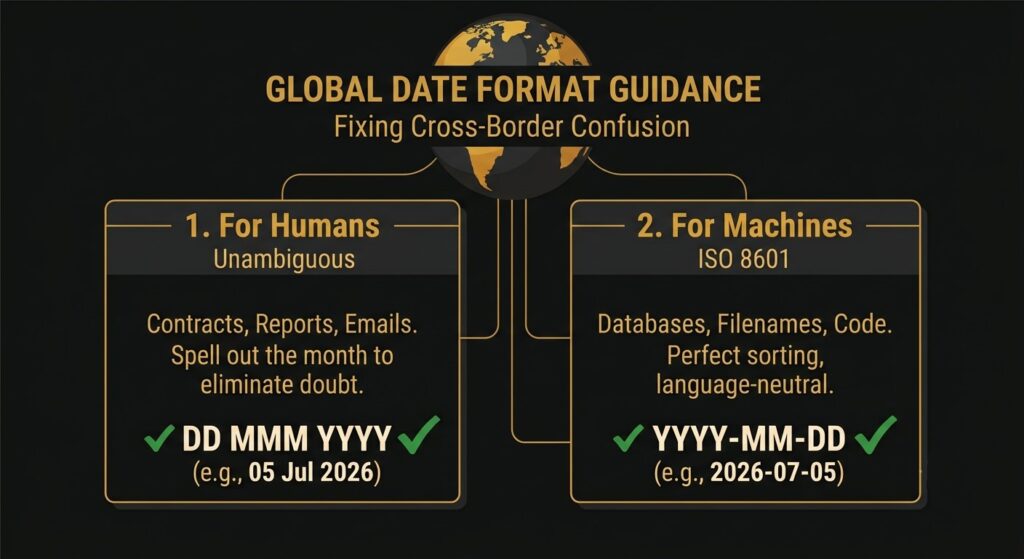
To eliminate confusion, we recommend using DD MMM YYYY (e.g., 05 Jul 2026) in all human-readable technical and business documents, unless a specific standard or system mandates otherwise. This format spells out the month, making the date unambiguous across cultures. ISO 8601 (YYYY-MM-DD, e.g., 2026-07-05) remains the go-to standard for machine-readable data, software, databases, and file naming.
This report covers:
- The history and origins of date formats.
- The major date formats in use globally.
- The details of ISO 8601 and related standards.
- Which industry standards do and do not prescribe date formats.
- Real-world risks from date ambiguity.
- Best-practice recommendations, including policy templates.
Sources: NASA/Markus Kuhn “ISO 8601” summary; IEEE Editorial Style Manual; FAA Form Notice; AUS/UK government guides.
1. History of Date Formats
The way humans write dates has evolved over millennia. Ancient Roman calendars used named months and festivals (e.g., “Ides of March”), and numeric dates were uncommon. In medieval Europe, dates were often written in full words (e.g., the 10th of March, 1585).
When numeric dates became popular, Europe gradually settled on a descending order of time units: day, month, year. For example, in the UK by the 19th century, 31/12/1899 was common in official papers.
In contrast, early American colonists largely inherited the British practice of writing month-day-year when speaking (e.g., “July 4, 1776”), and this pattern carried into written dates. The first U.S. federal documents often used MM/DD/YYYY. Over time, the UK and most other countries standardized on DD/MM/YYYY, but the U.S. held on to its format. In East Asia (China, Japan, Korea), dates traditionally go from largest to smallest unit (YYYY年MM月DD日 in local script). This corresponds naturally to year–month–day in numeric form.
In the 20th century, international commerce and computer systems made the need for an unambiguous date format acute.
| Gregorian Calendar Introduced | 1582 | Pope Gregory XIII introduces the Gregorian calendar to the Catholic world. |
| British Adoption | 1752 | Britain (including its overseas colonies) adopts the Gregorian calendar. |
| ISO 2014 Standard | 1976 | Introduction of the numeric date standard in ISO recommendations. |
| ISO 8601:1988 | 1988 | The first unified year-month-day standard is published to avoid regional confusion. |
| ISO 8601 Revisions | 2000 – 2004 | Updates to the standard ensure safer Year 2000 (Y2K) parsing and modernized guidelines. |
| Modern Standard (ISO 8601:2019) | 2019 | ISO 8601-1:2019 and ISO 8601-2:2019 are released, maintaining YYYY-MM-DD as the core data standard. |
Internet and data standards (RFC 3339, XML Schema, SQL, etc.) universally adopted ISO 8601 because it sorts chronologically and is language-neutral.
2. Major Date Formats Used Worldwide
Different regions use different numeric date conventions. Using only numeric dates (with slashes or dashes) is the biggest source of cross-border confusion. For example, 03/04/2026 could be 3 April or 4 March.
| Format | Example | Region / Context |
| DD/MM/YYYY | 05/07/2026 | Australia, UK, NZ, Europe (Official style for written documents) |
| MM/DD/YYYY | 07/05/2026 | USA (Long-standing convention) |
| YYYY/MM/DD | 2026/07/05 | China, Japan, Korea (Traditional order) |
| YYYY-MM-DD | 2026-07-05 | International data (ISO 8601 format) |
| DD MMM YYYY | 05 Jul 2026 | Recommended for human-readable technical docs & certificates |
Other variants: In some European countries, you may see dots (e.g., 05.07.2026) or roman numerals for the month (e.g., 05.xii.2026). Some systems still use two-digit years (e.g., 05/07/26), but these are strongly discouraged as they risk century confusion and Y2K-type errors.
The obvious solution is to avoid purely numeric formats when communicating across borders, and instead use a format that makes the month unambiguous (DD Mon YYYY).
3. ISO 8601 and Numeric Date Standards
ISO 8601 is the international standard that defines how to represent dates (and times) in a machine-readable way. Its basic date format is: YYYY-MM-DD (4-digit year, 2-digit month, 2-digit day).
Placing the year first (descending significance) ensures that date strings sort chronologically if compared lexicographically.
Why ISO 8601?
- It avoids ambiguity: There is no confusion about what each part represents.
- It is language-neutral: Highly computer-friendly across borders.
- It is the de facto standard: Used for software, APIs, databases, XML, and JSON.
- It minimizes parsing code: Designed to handle date sorting and system transitions safely.
Numeric vs. Written Dates
ISO 8601 only covers numeric dates. It explicitly does not specify formats with month names. In other words, ISO 8601 is for interchange and data, not for replacing human-readable styles.
In practice:
- Use ISO 8601 (YYYY-MM-DD) whenever dates are part of data exchange, databases, filenames, or digital records (e.g., 2026-07-05_report.pdf).
- In documents for people, organizations typically prefer DD MMM YYYY (05 Jul 2026) or full “5 July 2026” in prose, saving the ISO format for system use.
4. What Standards Specify (or Don’t Specify)
Many quality and management system standards mention dates, but very few mandate a specific format; most simply require organizations to use a consistent, controlled format.
| Standard / Guide | Mandates Format? | Required Format | General Guidance |
| ISO 8601 (ISO) | Yes | YYYY-MM-DD | The core international data standard. |
| RFC 3339 (IETF) | Yes | Derived from ISO | Used for internet protocols and APIs. |
| RFC 822/2822 (Email) | Yes | DD Mon YYYY | Includes weekday (e.g., “Tue, 21 Dec 2026”). |
| ISO 9001:2015 (QMS) | No | N/A | Requires controlled date formatting in docs. |
| ISO 13485:2016 (Med) | No | N/A | Requires defined formats in document control. |
| AS9100D (Aerospace) | No | N/A | Based on ISO 9001; define internal format. |
| IEEE Editorial Manual | Recommended | DD Month YYYY | Calls for DMY with spelled-out month. |
| UK Gov Digital | Yes (Data) | YYYY-MM-DD | Does not apply when human readability is key. |
| FAA Orders (8130.2H) | Yes (Forms) | DD MMM YYYY | Mandated for airworthiness certification forms. |
For standards like ISO 9001 that “do not specify,” the recommended practice is to define a clear, unambiguous format in your internal Quality Manual (such as DD MMM YYYY) and apply it consistently.
5. Risks of Ambiguous Date Formats
Using ambiguous date formats in technical or business documents has caused numerous real-world problems:
- Manufacturing delays: An electronics manufacturer shipped a batch of components late because a delivery note reading 03/04/21 (intended as 3 April in Australia) was read as March 4 by a US-based engineer.
- Contract disputes: A service contract listed a delivery date as 02/03/2026. The contractor assumed 2 March (DD/MM), while the client expected Feb 3 (MM/DD).
- Software bugs: In a multinational software release, a U.S. developer wrote 07/08/21 (August 7); a UK tester read it as 7 August. Version control failed to chronologically sort releases, causing a feature freeze on the wrong day.
- Customs/shipping errors: Import certificates dated 5/7/2023 resulted in goods being held at ports because officials misread the expiration as 7 May instead of 5 July, leading to spoiled goods and fines.
- Pharmaceutical incidents: An audit discovered expired calibration certificates where one country’s system recorded 12/01/24 (12 Jan 2024) while another read it as Dec 1.
In highly regulated industries, auditors routinely flag ambiguous dates as nonconformances. Consistent use of a clear format mitigates these risks.
6. Best-Practice Recommendations
Based on the above, the following practices are recommended for all engineering, technical, and business documentation:
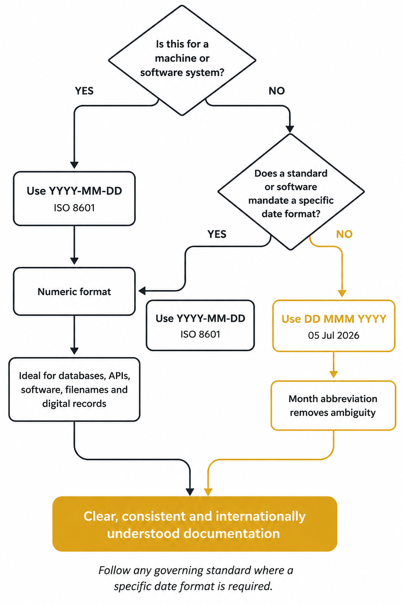
- Default to DD MMM YYYY for written documents: In narrative text, reports, manuals, letters, and certificates, use day-month-year with the month abbreviated or spelled out (e.g., 05 Jul 2026). “Jul” is unmistakably the month.
- Use YYYY-MM-DD (ISO 8601) for data and systems: In databases, filenames, interfaces, XML/JSON fields, and APIs, use ISO 8601 (e.g., 2026-07-05_spec.pdf).
- Avoid purely numeric DD/MM/YY or MM/DD/YY: Two-digit years (e.g., 05/07/26) should be avoided entirely. Mixing slashes or dots for numeric dates invites misreading.
- Consistency across systems: Ensure internal IT systems (ERP, CRM, CAD, PLM) are configured to match the organization’s policy.
- Audit and QA: Include format checks in your document reviews. Create checklist items ensuring dates follow the mandated DD MMM YYYY or YYYY-MM-DD format.
Decision Flowchart: Choosing a Date Format
7. Policy Examples and Templates
Below are sample text blocks that you can copy and adapt for your Quality Manual, Document Control Procedure, or company intranet.
Policy (Document Control Procedure):
“All dates on controlled documents (drawings, reports, certificates, forms, etc.) shall use the format DD MMM YYYY (e.g., 05 Jul 2026) with a four-digit year. This rule eliminates ambiguity between day and month.
Exception: When recording dates in computer systems, databases, or file names, use ISO 8601 YYYY-MM-DD as required (e.g., 2026-07-05). Two-digit years (YY) must not be used.”
Quality Manual Entry:
“We shall use a standard date format across all documents. For human-readable text, the preferred format is ‘DD Month YYYY’ (e.g., 5 July 2026) or abbreviated month (05 Jul 2026). This approach avoids the common confusion between DD/MM and MM/DD. Any electronic record or system interface requiring a numeric date shall use ISO 8601 (YYYY-MM-DD). This policy complies with international best practices and ensures consistency in our QMS documentation.”
8. Conclusion
Date formatting may seem like a mundane detail, but in global engineering and business, it can have massive consequences if handled poorly. The simplest way to remove this major source of error is to adopt an unambiguous standard.
For people-facing documents, the DD MMM YYYY format (e.g., 05 Jul 2026) is highly recommended: it leaves no doubt about which digits represent the day or month. For machine-facing systems, ISO 8601 (YYYY-MM-DD) is the undisputed ideal.
By documenting this dual-approach policy and training teams accordingly, an organization can avoid misinterpretation and costly errors. Pick a clear format for text, stick with it, and use ISO 8601 for systems. This simple measure will greatly improve communication, quality, and interoperability across your global operations.