
Knowledge Centre
Sharing the expertise behind successful engineering projects.
Engineering Simulation: The Missing Step in Product Design and Development
A product can look perfect in CAD and still fail when it is built.
A component may deform more than expected under load. An enclosure may become too hot during continuous operation. Airflow may not reach the areas that need cooling. A circuit may behave correctly on the bench but experience electromagnetic interference once it is installed inside the final product.
These problems are not unusual. They are part of engineering.
The problem is when they are discovered late.
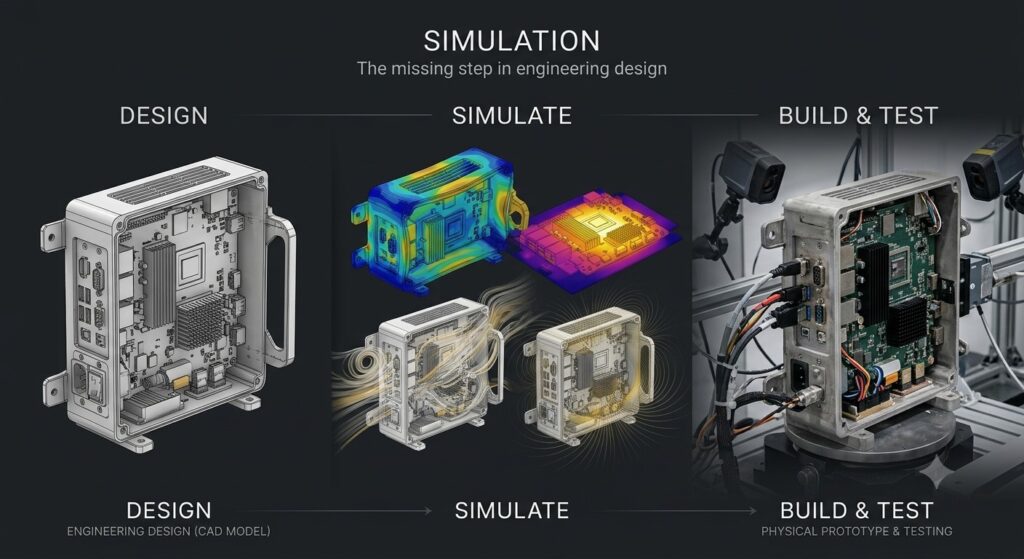
Traditionally, many products follow a familiar development cycle: design the product, build a prototype, test it, find problems, modify the design and build another prototype. Physical testing remains an essential part of engineering, but there is an important step that can sit between design and hardware testing.
Simulation.
Simulation allows engineers to investigate how a product is likely to behave before it is manufactured. It can show where a structure will experience high stress, how heat moves through an assembly, how air or liquid flows through a system, or how electromagnetic fields interact with an electronic product.
Used properly, simulation is more than a way of checking a finished design. It is a design tool.
That is why we see engineering simulation as the missing step between designing a product and understanding how it will actually behave.
What is engineering simulation?
Engineering simulation is the use of mathematical models, physics and computational methods to predict the behaviour of a real system.
Instead of building a physical object and observing what happens, an engineer creates a digital representation of the system and applies the relevant physical conditions.
Depending on the problem, this might include:
- Material properties
- Geometry
- Loads and forces
- Temperatures
- Pressures
- Fluid properties
- Electrical inputs
- Electromagnetic conditions
- Boundary conditions
- Environmental conditions
- Operating cycles
The simulation then calculates how the system responds.
For a structural problem, that might mean calculating stress and deformation. For a thermal problem, it could mean determining temperature distribution and heat flow. For a fluid system, it may involve calculating velocity, pressure and turbulence.
The important point is that simulation is not simply about producing a colourful image of a product.
A useful simulation answers an engineering question.
Will it withstand the load?
Will it overheat?
Where is the pressure loss occurring?
Can the structure be made lighter?
Will electromagnetic interference affect the electronics?
What happens if the operating conditions change?
Those answers can then be used to make engineering decisions.
Why simulation matters in product development
Physical prototypes tell you what happens to one particular physical design under a particular set of test conditions.
Simulation can allow engineers to investigate many more possibilities before committing to hardware.
Imagine an enclosure that is expected to dissipate 100 W of heat. There are several possible approaches to improving its thermal performance: change the material, increase the surface area, modify the internal layout, add ventilation, introduce forced airflow or change the position of heat-generating components.
Building and testing a prototype for every option can quickly become expensive.
A thermal simulation can be used to compare those options digitally and identify the designs that are worth taking forward.
The same principle applies to structural design.
If a bracket is failing, the answer may not simply be to make it thicker. A simulation may show that the highest stress is concentrated around a particular feature or mounting point. Changing the geometry in that area could produce a stronger component without adding unnecessary material.
This is where simulation becomes particularly valuable.
It allows engineers to investigate why something happens, rather than only observing that it happens.
The benefits can include:
- Finding potential problems earlier in the design process
- Reducing unnecessary physical prototypes
- Comparing design alternatives
- Improving product performance
- Optimising weight, material and geometry
- Investigating failures
- Reducing development risk
- Supporting design decisions with engineering data
- Understanding behaviour that is difficult to measure physically
- Shortening design iteration cycles
The financial benefit is not simply the cost of avoiding one prototype.
The larger benefit is being able to make better design decisions before changes become expensive.
The major types of engineering simulation
Engineering simulation covers a wide range of physical disciplines. The appropriate method depends on the engineering question being investigated.
Some products may require only one type of analysis. Others involve several physical effects that interact with one another.
The major areas include structural and mechanical simulation, thermal analysis, computational fluid dynamics, electromagnetic simulation, electrical and electronic simulation, and multiphysics analysis.
Structural and mechanical simulation
Structural simulation is used to understand how a component or assembly responds to forces, loads and other mechanical conditions.
One of the most common approaches is finite element analysis (FEA). The geometry is divided into a large number of smaller elements, allowing the behaviour of the overall structure to be calculated numerically.
Depending on the application, engineers can investigate:
- Stress
- Strain
- Deformation
- Static loading
- Dynamic loading
- Vibration
- Fatigue
- Buckling
- Impact
- Contact
- Non-linear material behaviour
A simple structural analysis might answer whether a bracket can withstand a specified load.
A more detailed analysis could investigate how a component behaves under repeated loading over its expected service life.
This distinction matters. A component that survives one load case may still fail after thousands or millions of cycles because of fatigue.
Simulation can also help with optimisation. Rather than simply increasing material everywhere, an engineer can identify where material is actually required and where it can potentially be removed.
The result can be a component that is lighter without compromising its required structural performance.
Thermal simulation
Temperature is often a secondary effect of another engineering process.
An electronic component generates heat. A motor produces losses. A battery generates heat during operation. A power converter dissipates electrical energy. A mechanical system may experience friction.
That heat has to go somewhere.
Thermal simulation is used to understand how heat moves through a system and how temperatures develop over time.
Depending on the problem, the analysis may consider:
- Conduction
- Convection
- Radiation
- Heat generation
- Thermal resistance
- Temperature distribution
- Steady-state conditions
- Transient behaviour
- Thermal gradients
For example, an electronic enclosure may appear to have enough physical space for all its components. That does not necessarily mean it has enough thermal capacity.
A simulation may show that a particular power component is creating a local hot spot, while other areas of the enclosure remain relatively cool.
That information can lead to a better design: move the component, change the heat path, improve the interface material, modify the enclosure or introduce additional cooling.
Thermal simulation is particularly useful when thermal performance affects reliability.
Operating an electronic component continuously above its intended temperature range can significantly affect its life. Finding that problem during the design stage is considerably easier than discovering it after a product has entered production.
Computational Fluid Dynamics (CFD)
Whenever air, water, gas or another fluid moves through a system, fluid behaviour can become an important part of the design.
Computational Fluid Dynamics, or CFD, uses numerical methods to model fluid flow and associated physical effects.
CFD can be used to investigate:
- Pressure
- Velocity
- Flow distribution
- Turbulence
- Pressure drop
- Heat transfer
- Internal flow
- External flow
- Mixing
- Ventilation
- Cooling
Consider a product enclosure with a fan.
Knowing the fan’s rated airflow does not necessarily tell you how well the final product will cool.
The internal geometry, vents, filters, component placement and pressure losses all affect the actual flow through the enclosure.
CFD can show where the air is going and, just as importantly, where it is not going.
This can reveal recirculation zones, stagnant areas, excessive pressure losses or components that are receiving insufficient airflow.
CFD is also useful outside electronics. Automotive systems, industrial equipment, HVAC systems, pumps, ducts, fluid handling equipment and many other products can benefit from fluid-flow analysis.
In many cases, the objective is not simply to calculate the flow. It is to improve it.
Electromagnetic simulation
Electromagnetic behaviour can be difficult to understand from physical dimensions and circuit diagrams alone.
Once electrical currents and changing signals interact with physical structures, electromagnetic fields become part of the engineering problem.
Electromagnetic simulation can be used to investigate areas such as:
- Electromagnetic fields
- EMI and EMC
- Electromagnetic coupling
- Crosstalk
- Shielding effectiveness
- Signal integrity
- Power integrity
- Unwanted radiation
- Susceptibility and interference mechanisms
This can be particularly important for modern electronic products, where high-speed digital signals, switching power supplies, wireless systems and densely packed electronics are increasingly common.
A PCB may perform correctly during basic functional testing but experience interference when integrated into the complete product.
The cause could be coupling between circuits, radiation from a switching node, an inadequate return path, enclosure behaviour or interaction between cables and other structures.
Electromagnetic simulation provides a way to investigate these mechanisms before relying entirely on trial-and-error hardware testing.
For EMC-related development, this can be particularly valuable because fixing an interference problem late in the development cycle can involve significant PCB, enclosure, cabling or mechanical changes.
Electrical and electronic simulation
Electrical simulation operates at a different level from electromagnetic field analysis.
Instead of primarily investigating how fields interact with physical structures, circuit and system simulation can be used to predict electrical behaviour.
Applications include:
- Analog circuits
- Digital circuits
- Power electronics
- Switching circuits
- Transient behaviour
- Power supplies
- Control systems
- Electrical systems
- Signal behaviour
- Component interactions
For example, a power supply may need to maintain a stable output when its input voltage and load change.
Rather than testing every possible operating condition on hardware, engineers can model the circuit and investigate how it responds to those changes.
Electrical simulation can therefore be useful early in development, before a PCB has been manufactured.
It can also complement physical testing by helping explain why a measured waveform, voltage or current behaves differently from what was expected.
Multiphysics simulation: when one type of physics is not enough
Real engineering systems rarely behave according to one physical phenomenon in isolation.
An electronic device generates heat.
Heat changes material properties and electrical behaviour.
Electrical current creates electromagnetic fields.
Fluid movement transfers heat.
Pressure creates mechanical loads.
Mechanical movement can affect electrical connections.
These interactions are where multiphysics simulation becomes particularly useful.
Consider a high-power electronic system.
The electrical model determines power losses.
Those losses become heat sources.
The thermal model calculates the resulting temperature distribution.
Temperature affects the components and materials.
The final temperature may then influence reliability and performance.
Looking at only one of these effects can miss part of the problem.
A similar situation occurs in fluid systems. Fluid flow can produce pressure and temperature changes, while those conditions can influence the mechanical structure containing the fluid.
Multiphysics simulation allows these interactions to be considered together rather than treating every physical effect as completely independent.
This is particularly useful for products where performance depends on several engineering domains interacting at the same time.
Simulation throughout the product development lifecycle
One of the common misconceptions about simulation is that it belongs near the end of the design process, after the product has already been designed.
It can be much more valuable when introduced earlier.
Concept development
At the concept stage, simulation can help determine whether an idea is physically feasible.
For example:
- Is the proposed cooling approach sufficient?
- Can the structure carry the expected load?
- Is there enough space for thermal management?
- Is a particular material suitable?
- Is the expected performance realistic?
At this stage, the model may be relatively simple. The objective is not to produce a final certification-level analysis. It is to avoid pursuing an impractical concept.
Detailed design
As the design becomes more developed, simulation can become more detailed.
Engineers can investigate specific geometry, materials, loads, temperatures, flow conditions and operating scenarios.
This is where simulation becomes part of the design iteration.
A geometry changes.
The simulation is run again.
The results are compared.
The design changes again.
That cycle can happen before another physical prototype is manufactured.
Design optimisation
Once the basic design works, simulation can be used to ask a different question:
Can we make it better?
That could mean:
- Lighter
- Stronger
- Cooler
- Quieter
- More efficient
- More compact
- More reliable
- Less expensive to manufacture
The goal is no longer simply to meet a requirement. It is to understand the available design space and find a better solution within the practical constraints.
Validation and testing
Physical testing still has an important role.
Simulation and testing are strongest when they are used together.
A simulation predicts behaviour. A prototype provides physical evidence. Test results can then be compared with simulation results.
If they do not agree, that difference is useful information.
Perhaps a material property was incorrect. Maybe a boundary condition was unrealistic. Perhaps a manufacturing detail was omitted from the model.
The process of comparing simulation with physical behaviour is called correlation, and it is an important part of building confidence in an engineering model.
Simulation does not replace physical testing
It is tempting to describe simulation as a replacement for prototypes and testing.
That is usually the wrong way to look at it.
A simulation is a model of reality. The quality of its results depends on the assumptions, inputs, geometry, material data, boundary conditions and numerical methods used.
A highly detailed model with incorrect assumptions can still produce a misleading result.
Physical testing therefore remains important, particularly where safety, compliance, certification or product validation is involved.
The more useful approach is to combine the two.
Simulation helps predict and investigate.
Physical testing helps verify and validate.
Used together, they provide much more information than either approach alone.
Simulation can also make physical testing more effective.
Instead of testing a large number of possible designs without knowing which one is most promising, engineers can use analysis to narrow the options first.
The prototype then becomes a way to confirm the engineering assumptions and measure the behaviour of the selected design.
What can simulation actually tell you?
One of the easiest ways to understand the value of simulation is to stop thinking about simulation types and start thinking about engineering questions.
For example:
“Will this component break?”
Structural analysis can identify areas of high stress and deformation under defined loading conditions.
“Where is the product getting too hot?”
Thermal analysis can show temperature distribution and identify potential hot spots.
“Why isn’t the cooling working?”
CFD can reveal how air or liquid moves through the system and identify flow restrictions or poorly cooled areas.
“Why is this electronics system failing EMC testing?”
Electromagnetic analysis can help investigate coupling, radiation, shielding and other possible interference mechanisms.
“Can we reduce the weight?”
Structural simulation can be used to investigate where material is actually contributing to the required performance.
“Can this design perform better?”
Simulation allows different geometries, materials and operating conditions to be compared without physically building every variation.
“What happens if the operating conditions change?”
Simulation can be used to investigate different loads, temperatures, pressures, speeds, voltages and other conditions.
These are practical engineering questions, and that is where simulation becomes useful.
Simulation is not only about finding failures
There is a tendency to associate simulation with failure prevention.
That is only part of the picture.
Suppose a structure is already strong enough.
The question may then become whether it can be made lighter.
Suppose an enclosure already stays below its maximum operating temperature.
The next question could be whether the cooling system can be simplified.
Suppose a fluid system already meets its flow requirement.
Perhaps the pressure drop can be reduced.
Simulation gives engineers a way to explore those possibilities.
This is the difference between design validation and design optimisation.
Validation asks:
Does the design meet the requirement?
Optimisation asks:
What is the best design that meets the requirement?
That second question can have a significant commercial impact.
Simulation for existing products
Simulation is not limited to new product development.
It can also be valuable when an existing product has a problem.
For example, a manufacturer may have a component that:
- Fails under certain loads
- Runs hotter than expected
- Produces excessive vibration
- Has insufficient cooling
- Experiences unexpected flow behaviour
- Fails EMC testing
- Performs differently from earlier versions
Building several new prototypes without understanding the underlying cause can become an expensive process of trial and error.
Simulation can be used as part of a failure investigation.
The objective is not necessarily to reproduce every detail of the original failure. Sometimes the more useful approach is to identify the mechanism responsible for it.
Once that mechanism is understood, the design can be changed with much greater confidence.
Common misconceptions about engineering simulation
“Simulation is only for large companies”
It is true that some simulation projects are highly complex and computationally demanding.
But not every engineering problem requires an enormous model.
A relatively focused simulation can answer a specific engineering question and provide useful information early in development.
The appropriate level of analysis depends on the problem.
“Simulation is only needed for complex products”
Even relatively simple products can have difficult engineering problems.
A small bracket can fail due to stress concentration. A simple enclosure can overheat. A basic PCB can experience EMC problems.
The physical size or apparent simplicity of a product does not necessarily determine whether simulation is useful.
“Simulation replaces testing”
It does not.
Simulation and testing serve different purposes and are most valuable when used together.
“The simulation result must be correct because the software calculated it”
This is one of the more dangerous assumptions.
Simulation software solves the mathematical problem it has been given.
If the geometry, material properties, loads or boundary conditions are wrong, the result can be wrong as well.
Engineering judgement remains essential.
“Simulation is something you do after the design is finished”
This is perhaps the biggest misconception.
Simulation can be most valuable when it influences the design before it becomes difficult or expensive to change.
When should you consider simulation?
There is no single point in a project where simulation suddenly becomes necessary.
It is worth considering whenever you have an engineering question that would benefit from understanding behaviour before, or alongside, physical testing.
Simulation can be particularly useful when:
- A physical prototype is expensive
- Multiple design alternatives need to be compared
- Failure would be costly
- The product operates under demanding conditions
- Thermal performance is important
- Structural reliability is critical
- Fluid flow affects performance
- EMC or EMI is a concern
- The product contains high-power electronics
- Testing a particular condition is difficult
- An existing product has an unexplained problem
- The design needs to be optimised
- You need quantitative information to support a design decision
The earlier the right question is identified, the more useful simulation can become.
The real value of simulation
It is easy to measure simulation by the number of hours spent modelling or the number of results produced.
That misses the point.
The real value is the engineering decision that the analysis enables.
A simulation that prevents a poor design decision can be more valuable than a highly detailed analysis that simply confirms something already known.
Likewise, a relatively simple model that identifies the likely cause of a failure can be more useful than a complex model that produces impressive graphics without answering the actual engineering question.
Good simulation starts with the question.
What do we need to know?
What decision will the result support?
What level of accuracy is appropriate?
What assumptions are reasonable?
What should be tested physically?
Those questions determine the right modelling approach.
Simulation as part of better engineering
The traditional product development process often looks like this:
Design → Build → Test → Find a problem → Redesign → Build again
Simulation introduces another step:
Design → Simulate → Improve → Build → Test
It does not remove the need for prototypes.
It gives the engineering team more information before committing to them.
That can change the way a product is developed. Instead of waiting for hardware to reveal every problem, engineers can investigate likely behaviour earlier and use that information to guide the design.
The result is not simply fewer prototypes.
It is a better understanding of the product.
How Twelvium approaches engineering simulation
At Twelvium, we view simulation as part of the engineering process rather than a separate exercise performed after the design is complete.
Our approach is to start with the engineering problem.
What is the product expected to do?
What is currently going wrong?
What conditions will it operate under?
What information is needed to make the next design decision?
From there, the appropriate analysis can be developed around the problem.
Our engineering simulation capabilities cover areas including:
- Structural and mechanical simulation
- Thermal simulation
- Computational Fluid Dynamics (CFD)
- Electromagnetic and EMC/EMI analysis
- Electrical and electronic simulation
- Multiphysics simulation
- Design analysis and optimisation
The different disciplines can also be combined where the behaviour of one physical domain affects another.
This is particularly important for modern products, where mechanical, thermal, electrical, fluid and electromagnetic behaviour can all interact.
Simulation can also be applied to an existing product. If a product is overheating, failing mechanically, experiencing unexpected flow behaviour or having an electromagnetic compatibility issue, simulation can help investigate the underlying engineering problem and evaluate potential solutions.
The objective is not to create a simulation simply because simulation is available.
The objective is to use the right level of analysis to answer the right engineering question.
The missing step
A physical prototype can tell you what happened.
Simulation can help you understand why it happened and what might happen if you change the design.
That distinction is important.
Engineering is rarely about producing one design and hoping it works. It is an iterative process of making assumptions, testing those assumptions, learning from the results and improving the design.
Simulation provides another source of engineering evidence within that process.
It allows engineers to explore ideas before manufacturing, investigate problems before they become expensive, compare alternatives and optimise designs based on more than intuition alone.
For some products, simulation may be relatively simple. For others, it may involve several interacting physical domains and detailed multiphysics analysis.
The principle remains the same:
Understand the behaviour before you commit to the design.
That is why simulation should not be viewed simply as another testing method.
It is a step between the idea and the hardware.
Design → Simulate → Optimise → Prototype → Test → Refine
The earlier that step becomes part of the engineering process, the more opportunity there is to make better decisions.
And in product development, finding an engineering problem in a simulation is usually much easier than finding it after the product has been built.